
Workflow improvement doesn’t always start with a new process. Sometimes it starts with a capacity problem.
When a team is drowning, the instinct is immediate: hire more people, buy another software tool, or deploy AI. Sometimes extra headcount is necessary. But more often, an organization already possesses all the capacity it needs: it’s just trapped inside operational friction.
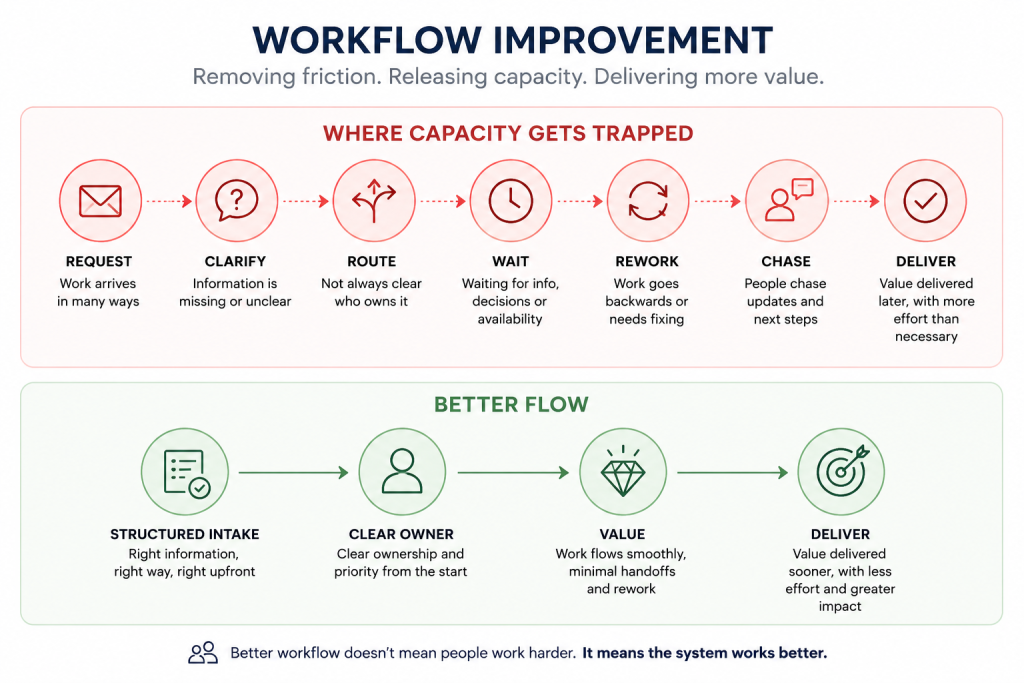
Requests arrive half-baked. Priorities aren’t obvious. Information is scattered across three platforms. Answers are written from scratch for the hundredth time. Status updates are continuously chased.
Individually, these papercuts look minor. Scaled across dozens of people and hundreds of projects, they swallow thousands of hours of high-value human expertise.
What is workflow improvement and how does it create capacity?
Workflow improvement isn’t an exercise in squeezing people to work faster. It is the systematic redesign of how work enters, moves through, and exits an organization.
Enterprise Ireland defines Lean thinking as aligning capabilities, processes, and systems with customer needs to build productive, competitive, and innovative enterprises. Similarly, Lean Business Ireland frames Lean as optimizing client value while streamlining work processes.
The objective isn’t simply “doing more with less.” It is designing work so that value flows without friction.
| Operational State | What It Looks Like | The Hidden Cost |
| High Friction (Busy) | Constant messaging, manual routing, chasing status, searching for context | Burnout, long lead times, trapped capacity |
| High Flow (Productive) | Structured intake, clear ownership, reusable knowledge, clear priorities | Speed, predictability, space for innovation |
In practical terms, workflow improvement usually focuses on five things:
- 1 – How work enters the organisation
- 2 – How it is prioritised and assigned
- 3 – How it moves between people and teams
- 4 – Where it waits, loops or creates rework
- 5 – How knowledge and information are reused
7 signs your organisation needs workflow improvement
A workflow improvement opportunity is likely when work depends on manual routing, unclear ownership, repeated status checks, rework or overloaded specialists. These seven signals show where operational friction is trapping team capacity.
1. Your best people have become human routing systems
When ordinary work depends on heroic individual effort and memory rather than defined roles and decision rules, you don’t have expertise—you have operational risk.
2. Email functions as your operating system
Long email threads hide ownership, context, and decisions. Information arrives inconsistently, turning daily operations into constant detective work.
3. Nobody trusts the status
If leadership must hold a meeting just to discover what is happening, your visibility is broken. Good workflow design makes the state of work obvious at a glance.
4. Work repeatedly moves backwards
Incomplete handovers, missing data, and unclear requirements force work backwards through the loop. Every loop burns capacity without adding value.
5. Silos optimize for themselves
Sales optimizes for speed, Operations for completeness, Finance for control. When each department optimizes locally, the overall customer journey gets fractured.
6. New technology hasn’t made work feel simpler
Digitizing a messy process simply gives you automated complexity. A platform only amplifies the workflow you give it.
7. Everyone is at 100% capacity, but lead times keep growing
When a system operates at maximum utilization with zero breathing room, work spends most of its life sitting in queues waiting for the next step.
Workflow improvement before automation: don’t automate waste
Workflow improvement should come before automation. Teams should understand, simplify and standardise the work first so digital tools and AI amplify a clear process instead of scaling waste.
- 1 – Understand the journey work takes.
- 2 – Simplify the steps and clarify decision rights.
- 3 – Standardize input data and request categories.
- 4 – Automate the frictionless process.
If you introduce AI into an inconsistent process, the AI simply inherits the confusion. Reusable knowledge, clear request taxonomy, and accountable decision-making must exist before automation can succeed.
Understand. Simplify. Standardise where useful. Then automate.
How workflow improvement builds lasting capability
Workflow improvement creates lasting capacity when teams learn to identify friction, analyse root causes and adapt through continuous feedback. Fixing isolated problems creates temporary efficiency; building improvement capability makes the gains repeatable.
Customer expectations shift. Markets evolve. AI will redefine knowledge work. The ultimate competitive edge isn’t having a perfect process today—it’s building an organization capable of refining its own processes tomorrow. This is why Enterprise Ireland’s LeanPlus program heavily emphasizes staff empowerment, culture, and sustained capability over short-term quick fixes.
How to start workflow improvement
You don’t need a multi-million-euro transformation to begin.
- Select one vital workflow where teams or customers feel daily friction.
- Map what actually happens today—not what the policy manual claims happens.
- Identify the loops, delays, and manual interventions.
- Implement 2–3 high-impact fixes and measure the capacity released.
Before you ask, “How much extra capacity do we need to hire?” ask the sharper question:
“How much capacity could we release by clearing the path for the people we already have?”
Sustainable performance isn’t about making people run faster.
It’s about making valuable work easier to do.
At Dadakai, we call that The Art of Changing.
Ready to see where capacity is getting trapped?
Dadakai helps organisations move from complexity to clarity and from vision to value through Lean thinking, business process improvement, coaching and human-centred transformation.
We work with leadership teams and the people closest to the work to understand current processes, remove friction, improve flow and build the internal capability to keep improving.
Your next capacity gain may already be inside your organisation.
Option ASome Conversations Change Things.
Growth, AI, grants, better operations, stronger teams. Whatever brought you here, it probably started with something you want to change.
Start the Conversation, Book a Call ↓Have a quick question first? Send us a message
No hard sell. Just two businesses seeing if there’s something worth discussing.
FAQ
What is workflow improvement?
Workflow improvement is the process of analysing and redesigning how work moves through an organisation to reduce unnecessary delays, handoffs, rework, ambiguity and administrative effort while improving customer value.
How can Lean improve workflow efficiency?
Lean helps organisations examine the flow of value, identify waste and unnecessary activity, understand root causes and continuously improve processes. The objective is not simply to make people work faster, but to make work flow more effectively.
Can process improvement increase team capacity?
Yes. Improving a process can release existing capacity when employees are spending significant time on avoidable administration, rework, searching for information, manual routing, unnecessary handoffs or other operational friction. The size of the opportunity should be measured for each organisation rather than assumed.
Should a business automate a process before improving it?
Usually, the process should first be understood and unnecessary complexity challenged. Automating an inefficient workflow can preserve or accelerate existing waste. Process redesign and automation can then work together.
What are the signs of a poor business workflow?
Common signs include repeated manual routing, unclear ownership, excessive email, duplicated data entry, frequent status chasing, rework, long lead times, inconsistent handovers and dependence on individual employees to keep work moving.
What is the difference between efficiency and flow?
Efficiency often measures how effectively an individual resource or activity is being used. Flow considers how smoothly work progresses through the entire process from request to delivered value. A series of individually efficient activities can still produce a slow overall workflow.
Is workflow improvement only for manufacturing companies?
No. Lean and workflow improvement can be applied to service operations, customer support, finance, technology, marketing, professional services and other knowledge-work environments. Enterprise Ireland itself describes Lean in terms of aligning organisational capabilities, processes and systems with customer needs.